
Farmer turned contractor Brett Allen has also cultivated a familiarity with the different and varying soil conditions throughout Wellington County.
That awareness is very useful in his role as the co-owner and hands/on operator of Postech Wellington. His partner Graham Wilkin purchased the franchise four years ago and then asked him to be a partner.
Postech Wellington is one of slightly more than 100 franchises across Canada who install galvanized steel helical piles as the structural support for residential projects such as patios, gazebos, tool sheds, and entire houses, as well as for commercial / industrial, and agricultural buildings.
“It’s somewhat like inserting a wood screw,” says Allen, in explaining the installation process.

He uses a mini Kubota excavator with an attachment arm on the bucket to install the seven-foot-long piles, which also come with five and three-foot extensions for challenging soil conditions where the piles may have to go deeper to support the structure. Each pile has brackets or ‘heads’ which can be connected to other supporting columns.
Not only can the piles be installed in any season, including winter, the postech pile system has superior benefits over the traditional method of excavating foundation holes, installing sono tubes into those holes, and then filling those tubes with concrete, he says.
As no earth is excavated, the owner, or the contractor they have hired, is not faced with the task of moving or transporting the soil offsite. Most installations can be completed in less than a day and then the owner (or contractor) can immediately proceed with construction.
The piles aren’t going to rot, are backed with a 75-year warranty and, under the Postech system, the load requirements of the piles are guaranteed, he says.
Depending on the type of project, the municipal approval process and his time to cost out the work may also be shortened.
With small-scale residential buildings, such as tool sheds or porches that aren’t going to be lived in, the homeowner may only have to provide a photo of the building site and a drawing to Allen, who can often prepare an estimate without even visiting the property beforehand.
Of course, the homeowner will still have to apply for a building permit and some municipalities are now requiring architectural drawings for porches with roofs, he cautions.
In the case of houses and more complicated commercial and industrial projects, the client needs architectural and/or structural engineering drawings.
Once the size and location of hose types of buildings has been determined, Postech Wellington forwards a copy of the drawings to their engineer who provides a specification document on the required ‘torque’ and type of pile required to create a solid foundation for the structure.
Torque is the turning force applied to the pile and there is certain formula which has to be adhered to ensure the piles can carry the structural loading of the building, he explains.
With every one of their projects, Allen and Wilkin submit a “torque report” to their clients, which they can use for clarification and accuracy of projects.
Each project is slightly different depending on size, application, snow loads and other factors. Ground conditions can also vary on the same property, says Allen, who had to alter his installation after discovering backfill on one site. “Backfill doesn’t have the same compaction as virgin soil.”
Despite the design and planning, placing the piles isn’t always straightforward. “In sandy soil it might take half a day to install eight piles. In rocky terrain, it could possibly take a full day.”
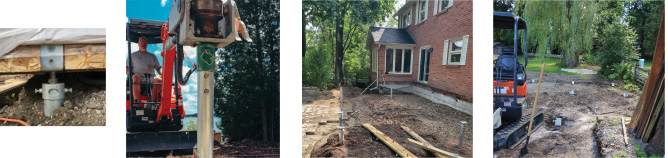
The specific requirements of each client can also add degrees of complexity. Just one example was the rather complicated installation of piles for a pagoda a client intended to add to her deck. At the same time, the client stipulated there be no damage to a cedar bush which was right in front of the deck. As there was no other access to the site, Allen had to temporary separate the bushes with a strap and then lift excavator’s arm over the bush and then guide the piles into place with the assistance of a part-time employee on the other side of the bush who was giving directions.
In another assignment, he had to carefully place the piles for a tool shed without damaging the root systems of a nearby oak tree the customer wanted preserved. In this particular project he was able to angle the piles just inches away from the roots.
“I can feel different resistance from tree roots or rocks,” says Allen, explaining it’s one of on-the-job skills he has acquired.
Of course, he had considerable construction experience long before his association with Postech. Born and raised on a farm in Kenilworth, helping operate the family farm while working in construction when he was younger, but decided to concentrate on construction solely.
For 17 years he was a supervisor with Quality Engineered Homes, a modular home builder, and then operated his own construction company for 10 years and that’s where he learned about and started using the Postech system.
“I loved the process and the product, so it was a quick decision,” says Allen, on his acceptance to be a partner with Graham Wilkin, a friend who he had previously collaborated with on other projects.
Wilkin is a second generation jeweler, who owns stores in Elora and Fergus. While it might seem a little odd that a jeweler is involved in construction, Allen says it’s “a perfect partnership”.
“Graham does all the information technology work, including submitting invoices, and I look after the field work.” Allen does most of that field work on his own, only using part time help as needed. That may change in the future. The partners recently purchased the Kitchener-Waterloo franchise and, as the business continues to grow, will be looking to expand and hire employees, he says.
WRITTEN BY: DAN O’REILLY | RESOURCES: POSTECH SCREW PILE, WELLINGTON COUNTY