
Intriguing and Fascinating Survivors of the Flinders Ranges, Australian Outback
We witness seeing the spectacle of Dust Devils, which are tall wide funnels of spinning winds that move across the plains carrying bits of rusty red dirt high into the sky. Once, we count five at the same time circling past us.
Australia, like Canada, is a huge country, with landscapes, flora and creatures that are quite different from ours. Most Australians live near ocean and beaches, around the perimeter coastline, and they rarely venture into the remote and sporadically inhabited interior Outback, which covers over 70 percent of the continent. There is continuous sunshine in the Outback, making it a parched environment of limited sparce scrub bush, dominated by vast openness and geological rock formations that date back over 800 million years. In certain land depressions, there are spots where Gum trees grow, enduring the dryness as it may be years or decades in between rains. Planning our return to Australia we decided to include a drive into this great arid land to quell our sense of wonder.
Our journey into the Outback begins from the scenic rolling hills of the coast near Adelaide, South Australia. Driving north towards Port Augusta, we pass alongside two massive inland ocean gulfs, 190 km wide. With minimal vegetation in sight, the expansive valley has several large-scale poultry operations and is dominated by 700-meter plus mountain ridges, topped by hundreds of wind turbines. The two huge above ground pipelines carry freshwater into the interior, and the extensive fields of mirrors and greenhouses are where seawater and sunlight are innovatively combined and converted into energy for sustainable agriculture. At Port Augusta, top end of the larger, Spencer Gulf, we turn off the main road and head towards the Outback.
From here on, all familiar signs of human civilization cease and the route inland ahead passes through a stark and barren terrain of orangey reddish colour. After passing the small village of Quorn, our views are the road straight ahead, with a low flat horizon as far as my eyes can see. Shrubs of hardy saltbush, bottlebrush and wattle, grow in intermittent clumps across the arid landscape. These have limited measly leaf growth to help maintain moisture and the prickles protect from being eaten. The occasional stands of sizable gums (eucalyptus trees) which have big trunks and sparce clusters of elongated rubbery leaves, are resistant through fire and drought, and defiant during floods. When rain comes, it causes flash flooding because of miniscule soil depth to absorb excess water. Gullies are quickly torn into low-lying land depressions, leaving behind loose rocks and debris. We pass abandoned homesteads, where sturdy pinkish rock walls still stand, but without windows or roofing. These remnants are from when colonial settlers tried to pioneer the Outback in the 1800s, but who perished from the merciless sun and lack of moisture from rain.
Strewn along the roadside are groups of peculiar round growths, the size of baseballs, laying among weathered leaves. These dessert squash, known as paddy melons, look like small watermelons, but they are poisonous and unusable. There are also endless batches of dried broken bones, those of dead grey and red kangaroos and wallaroos (cross between a wallaby and kangaroo) who became roadkill when they came to lick water off the pavement after rains. Although we don’t see gatherings of these creatures, we know kangaroos thrive here with few predator dingoes around to hunt them. Looking closely below scrub bushes, lounging kangaroos are often underneath, enjoying the shade of branches. These native marsupials have over developed lower bodies which are perfectly adapted for this rugged terrain of open land, where they nibble on vegetation and easily spring across plains, up rocky cliffs or through steep gullies.
Hours later, we see a line of mountains taking shape as the Flinders Ranges become clearly defined. Finally, we arrive at Wilpena Pound, Ikara – Flinders Ranges National Park. This is a modest resort, sheltered in a depression, surrounded by a natural geological wonder, amphitheatre of undulating crimson red rock mountain ridges. Wilpena Pound is the park’s only overnight hotel, offering rooms, safari tents, and parking for personal campervans. Our adorable cabin is well-appointed with full amenities and is nestled among a grove of mature gums. It has ceiling to floor windows on two sides, allowing us to feel a part of this marvelous natural oasis.
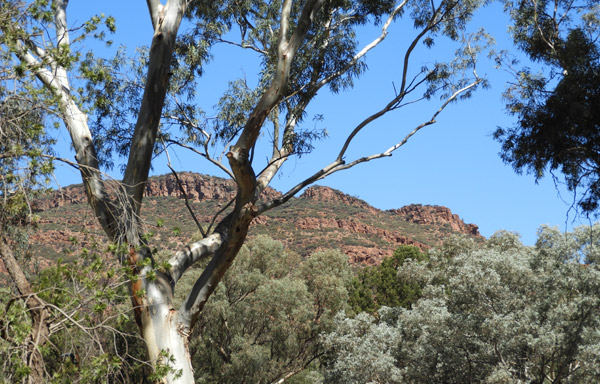
Ikara, means ‘gathering place’ to the local Adnyamathanha (Rock People). It is their culture to share extraordinary stories from the Dreamtime, and we have the honour to meet Issy, a local resident, and listen to his accounts of events which happened here long ago. One told of Yurlu (the kingfisher man) and two Akurra (serpents) when they were journeying to Ikara. As the people gathered in ceremony, a confusion of whirlwinds occurred and the Akurra surrounded and consumed them, later becoming the walls of the ranges, like those on either side of the Aroona Valley. It is intriguing that the visibly segmented rock wall sections we see today resemble undulating, intertwining bodies of Akurra (serpents). The local Adnyamathanha, (Rock People) have gathered at Ikara – Wilpena Pound with its surrounding mountain formations that resemble Dreamtime sleeping serpents for around 50,000 years. It is commendable that through perseverance of staying connected to their land, verbally sharing traditional language and the unique heritage of Dreamtime stories, the Adnyamathanha, Aboriginal people, have maintained a strong spiritual relationship with their ancestors.
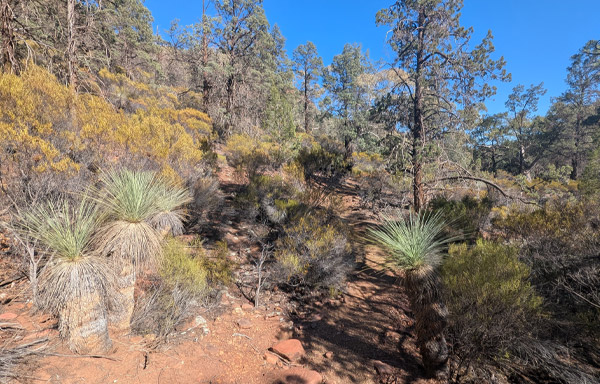
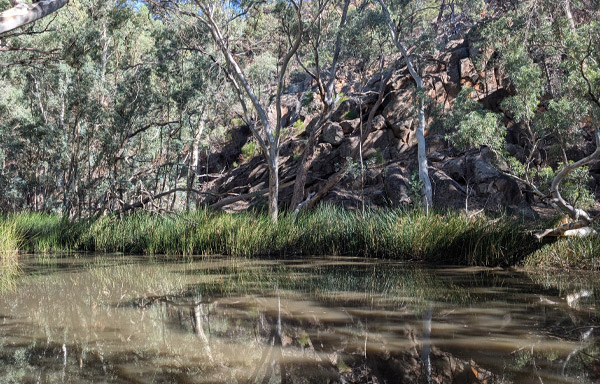
It is remarkable that with the area’s scarce rainfall (less than 300 mm annually) and limited soil, it can support flora of large gum trees, pockets of low scrub saltbush, spikey grasstrees, bunches of prickly wattle and stands of white cyprus pine. The shapely trunks of each gum tree at Ikara, whether smooth sided, stripey barked, or half dead and partly burnt out from fire, have impressive character shapes. The gums endure ongoing drought, living for hundreds of years and their steadfast roots sustain them during floods when torrents of swirling waters, with floating logs, pass by their gigantic trunks. We see evidence of previous flooding during our walk toward the Old Homestead and while exploring the dry riverbed of the Bunyeroo Valley and Gorge, where huge piles of deadwood gums have piled up from a great flood in the 1980s.
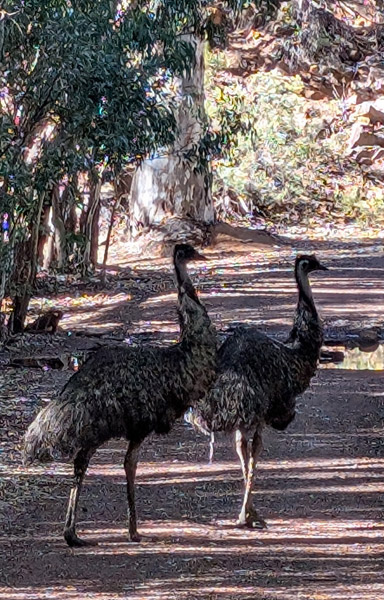
Another camouflaged wild creature, also two-legged like kangaroos, are the emus. Emus are huge flightless birds (weighing 40 to 60 kilos) with a long-necked featherless head and an oversized body adorned by long trailing plumage that flows around their long plump body like a skirt. The day we hike up the valley to the abandoned Old Homestead, we suddenly notice that we are following a pair of emus, silently striding only metres ahead of us on the trail. Matching their slow gate, for twenty minutes, we are speechless in their presence at close range and mesmerized by their gentle peaceful nature. Once we get deeper into the forest, the emus spot their mob, (group of emus) the pair scurry ahead to join in grazing for beetles and lizards in the brush of dappled light beneath a stand of old gums.
Our final day at Ikara we hike the Ngarri Mudlanha, also known as St. Mary’s Peak trail, passing through a spectacular Callitris forest of white cypress pine, which are naturally adapted to this semi-arid zone. A Dreamtime story of long ago, relating to this trail, tells of when people gathered in ceremony at Ikara, they saw large stars rising in the black night sky. The stars were the eyes of the two big Akurra (Dreaming serpents) looking down on them. Of the two great rock promontories we see along this trail, the highest and largest peak is believed to be the head of the female Akurra, which is sacred and forbidden to be climbed.
Our experiences in the Outback of Australia in the Flinders Ranges have been captivating and fascinating. The natural authenticity of this location brought us a deeper perspective and understanding of this unique environment and its people.
CYNTHIA PERCIVAL, WHILE EXPLORING BUNYEROO VALLEY AND GORGE, FLINDERS RANGES, OUTBACK, AUSTRALIA.