The past has become the future in Erin. The new library branch links history to growth in a wonderful new way.
Dominating Feature of the Town is Back
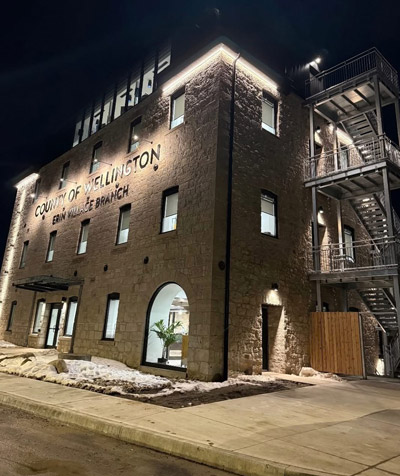
For over a century and one half, the McMillan Grist Mill has crowned the skyline of Erin. However, the last years, it has sat mainly vacant. “Old-timers” may still remember working there when it was still a chopping and feed mill. However, its history is much more storied and very much tied up to the beginnings of the town itself.
The first inhabitants were the Mississaugas of the Credit First Nation, from whom the land was bought by the British in 1818 with Treaty No. 19. European settlers arrived shortly after, including the McMillan family from Scotland. By 1829, 18 year old Daniel McMillan bought the first sawmill built by the Trout family in 1826, using the Charles Street dam for its power. Gutted by fire, he renovated it himself and cleared three acres of land. He also built Erin’s first house in 1834. With his two younger brothers, they grew the village to be known by its early spelling of “Macmillan’s Mills”. Over the next twenty years the brothers built and developed three dams and millraces, plus seven more mills. They included another sawmill, and also oatmeal and grist mills for flour. The last one was begun in 1847 to meet the needs of the growing village and demand for flour. The County’s longest flume for water was hand dug by locals under Main Street and nicknamed the “Big Ditch”. One hundred stone masons were brought in from Scotland to build the walls of the towering six story building! He personally went to Toronto with his brother and best friend to bring back the two millstones in the friend’s conestogo wagon.
The scheduled opening was for Christmas 1849, but Daniel McMillan would never live to see it. At the young age of 38 he died of blood poisoning within three agonizing days of getting a splinter into one of his fingers, on December 17th. In his short lifetime he had also helped plan roads, schools, stores, forge and other necessities, besides working in the cooperage he ran with his brothers. The first post office arrived in 1831, and by 1851 the village of 300 changed its name to Erinville, likely becoming Erin in 1880, when incorporated as a village.
At the time it was an engineering marvel, with the latest technology.
The McMillan family sold the building in 1872. It went through many owners afterwards because of change and related economics. Two fires in 1872 and 1946 caused a lot of damage and rebuilding. In 1959 it was electrified by the United Co-operative of Ontario to be a chopping and feed mill into the 1970’s; later sold to Mundell Lumber, it was used for storage until sold again in 2017 when it remained vacant.
How It All Came Together
The first Erin Social Library was a private society with subscribers around 1854, but the first public library was established in 1891 in a store. In 1997 the County of Wellington took over the libraries when twenty municipalities became the seven today. Over the years it moved a number of times, most recently being housed in Erin’s Centre 2000, sharing space with the Erin District High School.
In the 2000s the decision was made to revamp the library system with new or restored facilities. Five of the fourteen in the system are Carnegie libraries in Mount Forest, Harriston, Palmerston, Fergus and Elora. Andrew Carnegie, who had a self-made fortune, also had strong belief in and passion for free education, and created over 2500 free public libraries around the world promoting literacy. The last to be refurbished is the Erin branch. The lease in Centre 2000 was ending in 2025. The County needed a library there and the school board wanted more space, so the search began in 2021 to find a new location. In 2022, 4.75 acres was bought from the latest owner, along the west branch of the Credit River, with frontage on Main Street and including the mill building, the last mill left standing of the seven in Erin.
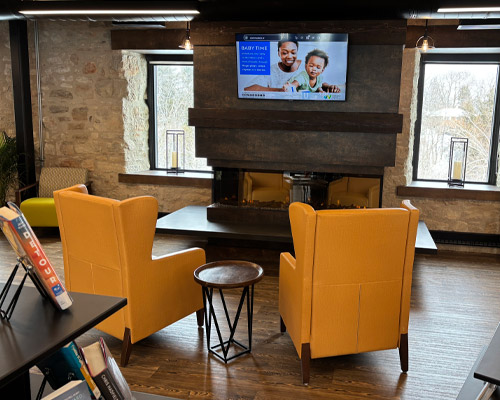
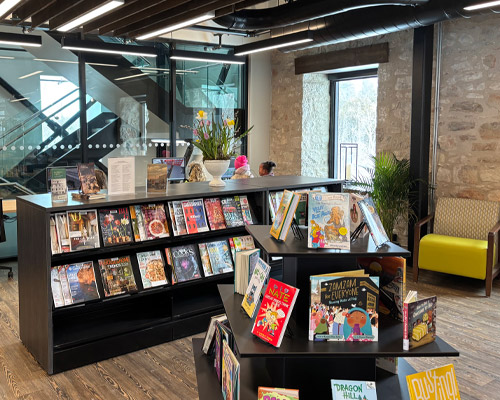
The interior of the dilapidated mill, with its falling in roof, was gutted for the renovation leaving the stone “skin”. Essentially, a new metal framed building was built inside of it to house the new library. Timbers were salvaged and reused, some for the innovative ceiling to cut noise. The “Big Ditch” flume originally providing water power was discovered and exposed with a glass floor. Daniel McMillan’s original millstones were recovered and grace the entrance.
Stonemasons of the 21st Century were impressed by the skills of the those from the mid 19th. The same company who restored the Elora Mill did the work here. In all, the library is now a whopping 14,000 square feet, at a cost of $12.9 million (two thirds was from reserves but one third is from development charges too, with no new tax money used!). Affordable housing is also planned for the site.
More than Books
Besides maintaining Erin history, the restored mill provides many other advantages. For one, it will help anchor the downtown for the anticipated population growth to 10, 800 persons. Another is as a tourist draw.
The library will offer more than books! It also will feature fireplaces with seating, a 3D printer and computer station, and programming and children’s spaces. People will be able to borrow the likes of sewing machines and radon kits too.
The top floor offers spectacular glassed-in views of the West Credit River and surrounding rolling countryside which the “Old Timers” never got to see. This area will be offered for rent or lease in the future for events, complete with kitchen facilities, which can be accessed separately from the main library.
As an economic generator, it is anticipated to be used by 40,000 persons. A champion of the project has been Jeff Duncan, chair of the county’s economic development committee and library board member. The Town Of Erin area is his ward. Of course, the local merchants and Chamber of Commerce were supportive of the project as well.
The new library pays homage to the founders of Erin, yet brings it into the future and beyond by such imaginative reuse of a heritage building, foregoing its loss by demolition like so many. And of course, is highly visible again in the Erin skyline!
WRITTEN BY: DIANA JANOSIK-WRONSKI