
Growing up, I had my own personal Narnia where I could retreat. During childhood and early adulthood, I lived on the street abutting Wychwood Park in downtown Toronto. Two thirds of the way down my street, there was the “secret gate” through which I could disappear along a narrow path lined with big ancient shrubs creating arches overhead, and come out into the meandering road of the park and a different world. I had a public school friend in there with whom I often played and we also went tobogganing on what was then called “Coleman’s hill” spreading down from one of the properties set back from the road. Later, I even wrote many a university essay in my head walking around there at night, and then coming back home to put pen to paper (as it literally was then!).

What is Wychwood Park?
Wychwood Park is a few minutes drive and an easy walk west, crossing Bathurst Street, from Casa Loma along Davenport Road. It is a private and gated residential community of about 60 homes, that was essentially one of the first of the planned communities in Canada. It is not a well-known part of Toronto to the public, but a very distinct and historical one. In 1985, moved by the threat of demolition of a significant property, it was designated as a Heritage Conservation District under the Ontario Heritage Act because of its uniqueness, described as “a landscape with houses set into it” and that it is “far more than the sum of its buildings”.
Wychwood Park was the brainchild of landscape painter Marmaduke Matthews in 1874, who built his home there, the Park’s first house. The subdivision plan was registered and a park reserve and trust for property owners was established in 1891. It is still run by a Board of Trustees. Although amalgamated with the City of Toronto in 1909, it is officially not part of the City of Toronto. This Board oversees the private roads, community services and parkland within the neighbourhood, and a special park tax is paid by every home owner there varying with the property.
How It Came to Be
Davenport Rd. is originally an old First Nations route which skirted the big hill south of St. Clair. That hill is in fact, the old shoreline of Lake Ontario when it was the much larger Lake Iroquois during the Ice ages around 13,000 years ago, and about 100 feet higher than today. Piercing the hill are a number of ravines, and one of these was chosen to create the park in the late 19th century.
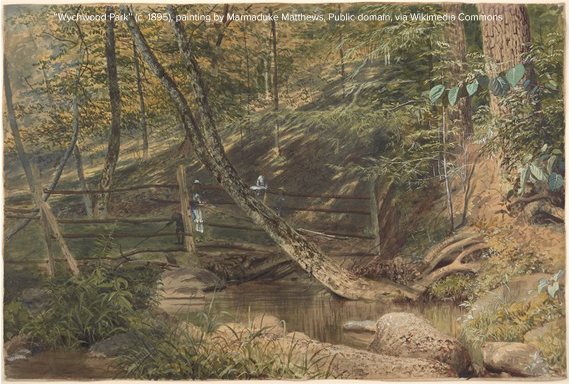
Artist Marmaduke Matthews chose this glade in what was then the undeveloped fringe of Toronto. In keeping with the then buccolic surroundings, he named it after Wychwood Forest in Oxfordshire, England, where he had grown up. A founding member of the Ontario Society of Artists in 1872, he also became a member of the Royal Canadian Academy in 1880. He was one of several artists commissioned by William Van Horne to paint pictures of the scenery along the new CPR train line out west, to promote it.
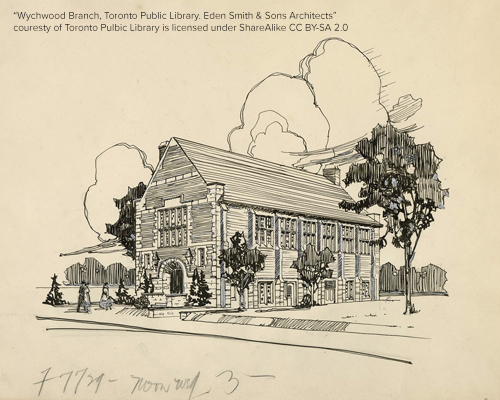
Businessman and friend Alexander Jardine entered the picture in 1877. The second house built there is his, named Braemore, and he also bought 12 acres more to add to the area. The two men created a community plan by 1888. Lots were irregularly shaped, surrounding a central park with a pond and tennis courts. The pond was created by damming Taddle Creek, flowing from the north and through the City of Toronto and the University of Toronto grounds. It is the only place the creek is still visible! Arthur Edwin Whatmough was the architect who designed the park and built several houses there between 1919-25. Noted architect Eden Smith also built his own home there in 1907, as well as several others. Both architects were noted for using the simple Arts and Crafts style, in the traditions of pre-industrial England and blending in with the landscape. Many of the mature red oaks and white oaks in the Park in fact predate the settlement of York!
Wychwood Park Today
Today’s park is still the village it has been in atmosphere and basic operation, where everyone knows each other. It has been the home and associated with many Canadian luminaries, such as Marshall McLuhan, corporate presidents, journalists, a federal minister, and artists like muralist York Wilson (whose work dominates the Meridian Hall lobby in downtown Toronto, in addition to other buildings).
It also has its share of modern problems. Few of the homes remain in original family hands. The Trust Deed has become a bone of contention for decades, especially with regards to the levy for each home. There has even been a scandal of slashed tires because of someone’s indignation with the increasing amount of vehicles parked at the sides of the road.
Overall, it still retains its “magic” as a forested oasis from another time, inside bustling downtown Toronto.
WRITTEN BY: DIANA JANOSIK-WRONSKI