
Trekking in a distinctively unique Alpine rainforest and moorland of rare flora and captivating creatures.
Cradle Mountain National Park, dominated by its distinctive grand twin saddle-shaped peaks of igneous rock, is a UNESCO World Heritage Site, which includes 1.4 million hectares of wilderness, lying in the mountainous mid-west of Tasmania, the big island south of Australia. Tasmania is separated from the mainland by the 240 km wide Bass Strait. The park’s native endemic plants, have evolved for tens of thousands of years, acclimatizing to the distinctive soil and mountainous weather conditions of this unique habitat and ecosystem of Tasmania. The park has picturesque pathways that weave through open grassy moorland of buttongrass, and ooze with small streams and rainforest gullies of mossy beech, conifers, and gums, before extending to higher elevations past alpine tarns (lakes), towards the bare jagged peaks of Cradle Mountain itself.
We are staying at the Highlander, near to the park’s entrance, in their Bushman’s Hut, a fully appointed 14’ x 20’ cabin, which is walking distance from the welcome centre. From here, park shuttle coaches take hikers into the heart of the park for day use. We want to explore the habitat, view its spectacular scenery and see endemic flora and fauna. Being late April, autumn plants are seasonally colourful, like the native plum, pink mountain berries and mountain rocket seed pods, which are baring fruit.
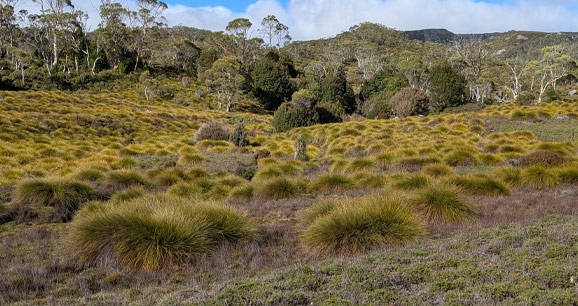
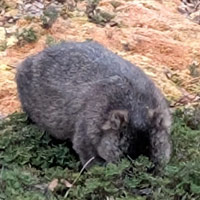
Our first ramble starts from the Romney’s Creek drop off, where we follow wooden boardwalks, conveniently covered in a metal meshwork for safe slip free stepping through this moist moorland terrain of occasional trickling streams. The lower elevation moorland is carpeted in green mounds of mossy cushion plants and a type of Pandani, palm like tree, which is topped with a single cluster of long pointy leaves. Thousands of metre wide tussocks of buttongrass grow here in the open moorland. These intriguing mounds are perfectly shaped clumps, with hundreds of thin 60 cm long leaf blades that extend up and out from a central spot in the ground, forming what look like giant green Hedgehogs. We share this enchanting terrain with an abundance of plump wild Wombats, which wander freely over the undulating heath. Wombats are adorable furry creatures, with four short legs, keeping them close to the ground, weighting 20 to 40 kg and growing up to 85 cm in length. Their unpredictable grazing manoeuvres, looking for choice grasses and roots, produce distinctly odd cube-shaped poop. We are captivated by these chubby chunks of dusty brown fur as they curiously meander, then suddenly scurry off in irregular directions the instant they sense we are too close for comfort.
The Marion’s Peak Lookout trail, with its significant terrain changes while climbing hundreds of steps up, passes various rare species of short-stemmed flowers, before reaching its final elevation of 1,223 metres up. After Wombat Pool, a high mountain tarn (lake), the rock landscape becomes seriously steep and uneven, which requires a hiking pole in the easy parts, and hand holds on the steeper segments. When we finally reach the precipitous lookout and stop for snacks, the panorama of wilderness all around is an open rolling valley basin of forest, sparkling blue crater lakes, plus the undeniably majestic bare rock peaks of Cradle Mountain. While descending, the breathing is easier and thinking is clearer, so I really enjoy the diversity of alpine and woodland trees; snow and yellow gums (Eucalypt) fagus (deciduous beech with ribbed leaves) and myrtle beech (shiny leaves) as we pass by them.
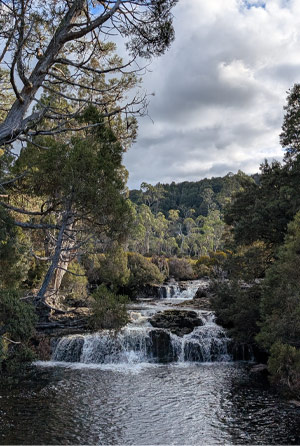
Exploring the riverside woodland trail near to our cabin one evening, we see pairs of wallabies, foraging for leafy grasses ferns and shrubs in the enchanting green mossy forest. Wallabies look like small kangaroos, who are taller with stronger legs, evolved to hop faster making them more adapted to open land. Both are marsupials, whose babies are born tiny and furless, then nurse and develop in their mother’s pouch for seven to ten months before full independence. At the waterfall we are excited to see a platypus swimming in the pool below the drop. Each small furry platypus only weighs from 1-2.5 kg. Its physiology of webbed feet, a characteristic oversized snout that looks like a duck’s bill, and a flat beaver like tail, make it perfectly designed for underwater maneuvering, poking around for aquatic insect larvae, freshwater shrimp, crayfish, and worms to consume. Platypus are aquatic egg laying mammals, whose babies are known as puggles.
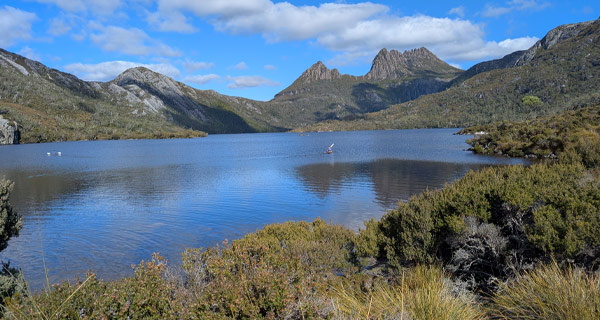
The 6 km. trail that encircles Dove Lake, is a favourite as it follows the perimeter of the lake along a flat wooden boardwalk, covered in slip proof wire mesh. There are viewing platforms and pathways down to small waterfronts, exposing alluring scenes of the Cradle Mountain peaks, which tower over the surrounding forest. The trail passes by a rock cliff section, goes through deep forest, then beside an open meadow, finally bringing us close to a mirroring lake and overhead bluff. It displays a continuous array of unique species of trees and shrubs to see and identify. The two hour Dove Lake circuit is Cradle Mountain’s signature hike and one which can be enjoyed at any season. It’s best to be prepared for this remote location with versatile layers of clothing, which includes a hat, mitts, plus rain gear and a warm jacket at any time of the year.
I always respect the wilderness by leaving it clear of my passing and I take away only memories and photos. As this marvelous paradise visit ends, I feel grateful these precious lands around the Cradle Mountain peaks are completely protected.
WRITER AND PHOTOGRAPHER CYNTHIA PERCIVAL AT DOVE LAKE, CRADLE MOUNTAIN NATIONAL PARK.