

The Hamlet of Pangnirtung on Baffin Island, Nunavut, is among the creative and artistically inclined Inuit known for its weaving. In particular, Nunavut’s iconic close fit, circular hat is known as a “Pang hat”, with matching scarves and mitts, famous for its distinctive pattern.
The coastal community of 1500 people in the Canadian Arctic, by Auyuittuq National Park, is primarily a fishing community, supplying Europe and Southern Canada directly with turbot (a large, left eyed flatfish) caught through ice fishing using traditional Inuit methods.
The same sort of hands-on Inuit knowledge is being successfully applied to the Hamlet’s secondary industry – arts and crafts production.
Weaving in Panniqtuuq (Pangnirtung) began as part of the new cash economy in Nunavut in 1970.
“Tapestry brought the textural richness of the woven medium to Inuit pictorial storytelling, adding a new dimension to the collective cultural voice,” explains The Pangnirtung Tapestry Studio pamphlet. “By adapting the skills of handwork and the trained eye of the maker to weaving the stories of their past, the Pangnirtung weavers keep them alive for future generations.”
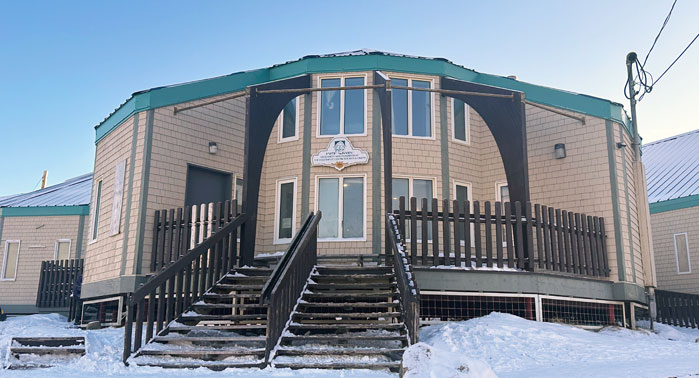
The Iqqurmiut Arts and Crafts Centre takes its name from the centre’s location, on the leeside of the mountain which forms part of the community, and means “people of the leeside.”
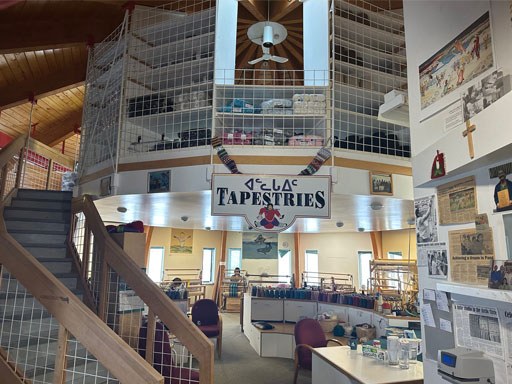
It is a community-based, not for profit Inuit corporation, formed in 1994, designed to serve Inuit artists in preserving and promoting their cultural and artistic heritage. Home to the tapestry studio and craft shop, as well as the Drawing Archives, the Pangnirtung Print Shop, administrative buildings, and the Iqqurmiut Inuit Gallery, it was built to support the burgeoning industry, which not only makes hats and blankets but elaborate, one-of-a-kind tapestries depicting scenes from Inuit life.
“The centre also works to preserve the fragile artistic record of the culture and traditions of the Inuit of the Cumberland Sound region,” the Nunavut Development Corporation further explains. “It contains an archive of over 8,000 original drawings that document the Inuit culture of Pangnirtung residents. These drawings provide inspiration for the tapestries and prints created at the centre.”
“The three buildings of the Iqqurmiut Centre are a significant presence for Inuit arts and crafts in the Nunavut economy. They also provide the community with a major share in one of the most important economic activities on Baffin Island.”
Tapestries from Pangnirtung are on display in many prestigious collections such as the National Gallery of Canada, the Musee des Beaux Arts in Montreal, the McMichael Canadian Art Collection, the Canadian Museum of Natural History, as well as gracing the walls of the Nunavut Legislative Assembly and other Nunavut and Northwest Territories government buildings.
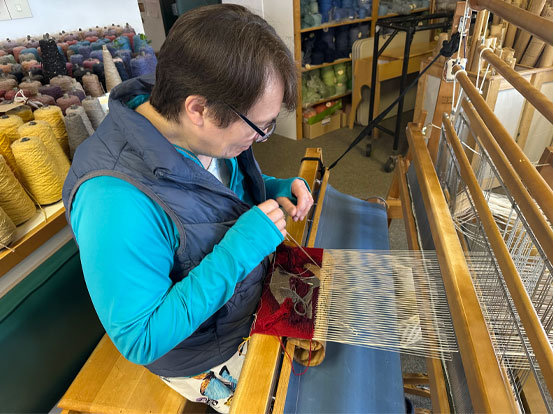
The centre buys art directly from local Inuit, as well as employing full-time weavers who work 9 to 5, five days a week, all year round.
The six Inuit women employed work out of the extremely peaceful studio, which is designed as an igloo structure. The radio plays in the background as the women not only weave, but watch children and greet the artists from the community coming in to sell their work twice a week.
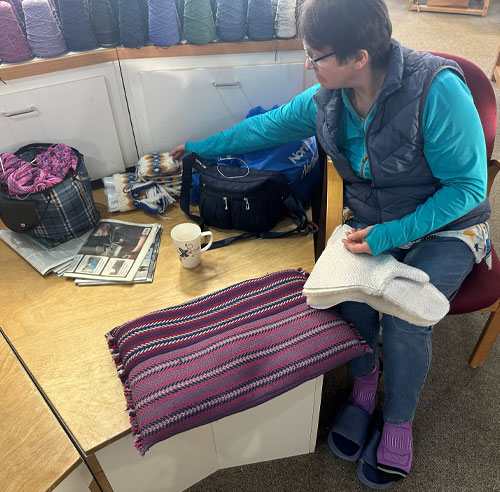
One visitor brings in some country food, traditional Inuit fare hunted around the community, meant to be shared and eaten raw. Today’s fare is tuktu, or caribou, which is carved up on one of the tables in the studio.
Original Inuit drawings, also for sale in the shop, from well-known Pangnirtung and Nunavut artists, forms the basis of the largescale tapestry pieces commissioned by private and corporate clients.
“Each tapestry is a collaborative effort between the artist who provides the original artwork and the tapestry artists who interprets it into a vibrant and rich textural artwork,” the pamphlet elaborates.
Pangnirtung, which is a stop for the growing tourism industry’s Arctic cruise ships, sees a distinct uptick in tourism during the summer months. During the off-season, the centre might see two or three customers a day, but during the tourism season, the cruise ships can carry a hundred passengers, who come down in groups to visit the centre, while the daily customer count goes up significantly with visitors to the national park.
Pang hats are best sellers, as well as the hand-crafted Inuit jewellery. Big business also comes from mail orders, where customers from anywhere can request specific colours for the famous hats and scarves.
The Pangnirtung Tapestry Studio and the community itself is worth the long trip, which involves flying through Ottawa, to Iqaluit, then on to Pangnirtung itself. The breathtaking handiwork and scenery of the small Arctic community is, like the artwork itself, unique.
WRITTEN BY: KIRA WRONSKA DORWARD